
MDI and peak-hour charges: how Pakistani factories can cut them
How MDI and peak-hour charges work on Pakistani industrial bills, with 2026 NEPRA rates, worked examples and ways to lower both. Check yours.
- Published
- Reading time
- 6 min
On this page9 sections
An industrial electricity bill in Pakistan charges you for two different things: how many units you use, and how much power you draw at once. The second is the maximum demand indicator, or MDI. Peak-hour pricing then changes what each unit costs depending on when you use it. This guide shows how both work on B2 and B3 connections, with the rates NEPRA approved on 11 February 2026, and where one saving can cancel the other.
The rates behind both charges
| Tariff | Connection | Peak (Rs/kWh) | Off-peak (Rs/kWh) | Fixed charge |
|---|---|---|---|---|
| B2 time-of-use | 25 to 500 kW at 400 V | 35.68 | 22.83 | Rs 1,250 per kW per month |
| B3 time-of-use | Up to 5,000 kW at 11 or 33 kV | 35.68 | 23.67 | Rs 1,250 per kW per month |
These apply to the state-owned distribution companies and K-Electric, and run to the end of December 2026 [1][2]. They exclude fuel and quarterly adjustments and taxes, so your final cost per unit is higher.
A separate package prices some extra industrial consumption above a past reference level. NEPRA provisionally raised that rate from Rs 22.98 to Rs 25.30 per unit from November 2026 billing and sent the decision to the federal government for notification [3]. The base rates above were not part of that change. If your bill shows incremental units, ask your distribution company how yours are calculated.
How the MDI charge works
Your meter records the highest demand you draw in the billing month. You pay the fixed charge on that figure, or on 25% of your sanctioned load if that is higher [1].
Take a B2 plant with a sanctioned load of 400 kW. Its floor is 100 kW.
| Recorded MDI | Billed demand | Fixed charge for the month |
|---|---|---|
| 80 kW | 100 kW (the floor) | Rs 125,000 |
| 220 kW | 220 kW | Rs 275,000 |
| 260 kW | 260 kW | Rs 325,000 |
Holding the peak at 220 kW instead of 260 kW saves Rs 50,000 in that month, or Rs 600,000 over twelve such months. Below the 100 kW floor, lowering the peak saves nothing on this line.
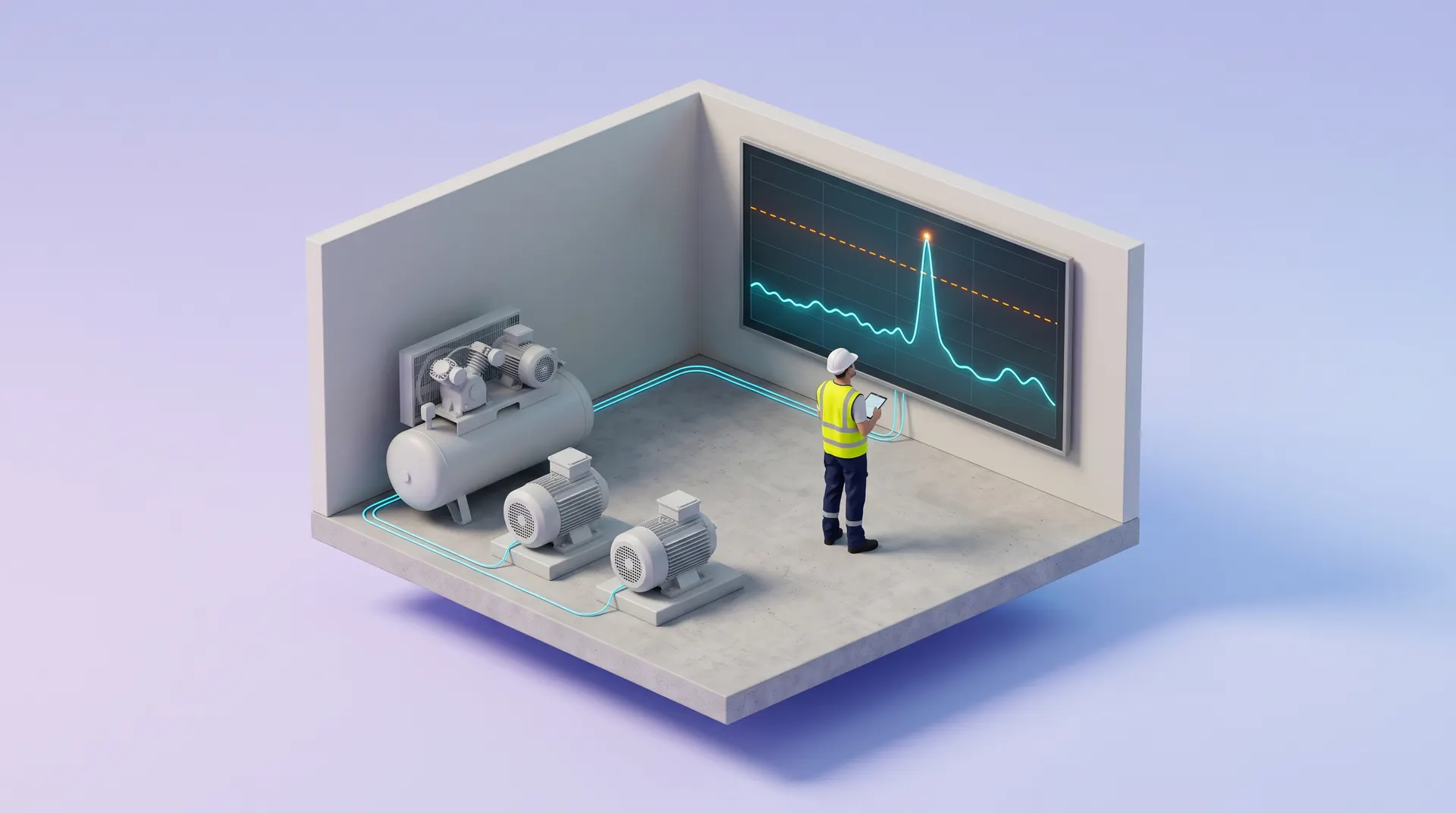
One bad start can set the figure. If two large motors and a compressor come on together after a power cut, that moment may decide the charge for the whole month.
How peak-hour units add up
Time-of-use meters price each unit by the hour it was used. Peak hours change with the season and are printed on your bill, so take them from there rather than from a website.
Say a 40 kW pumping job runs for three hours a day during peak time. That is 120 units. Moving it off-peak on B2 saves 120 × Rs 12.85 = Rs 1,542 a day, or about Rs 40,000 over 26 working days. On B3 the same move saves about Rs 37,500.
The trap: saving on units and losing on demand
Suppose you move that pump into an off-peak hour when the plant is already near its monthly maximum. The pump now adds 40 kW to the MDI.
| Effect on a B2 bill | Per month |
|---|---|
| Energy saved by shifting 3,120 units | Rs 40,092 saved |
| 40 kW added to MDI at Rs 1,250 | Rs 50,000 extra |
| Net result | Rs 9,908 worse off |
The same shift into a quiet hour, where the total stays under your existing maximum, keeps the full Rs 40,092. So the question is not only "is it off-peak?" but also "what else is running then?" You can answer it only with a load profile: power readings over time for the whole plant and for each large load.
How to cut the MDI
- Find the moment that set last month's peak. Look at the day and time of the highest reading and list what was running.
- Stagger large starts. Write a start-up order for compressors, chillers, mills and large motors, with a gap between each. Include the restart after load-shedding or a grid trip.
- Separate heavy batch work. Do not let two high-demand processes overlap if either can wait.
- Alert before the peak, not after the bill. Set an alarm below your target so a shift engineer can hold the next load.
- Review sanctioned load. Because of the 25% floor, a sanctioned load far above what you use can keep the charge high. Changing it is a formal application to your distribution company, so weigh future expansion first.
How to cut peak-hour units
- List the loads that can run at another time without hurting production: water pumping, charging, some batch processes.
- Check each against the plant's off-peak profile, using the test above.
- Switch off idle equipment in peak hours first. It needs no rescheduling.
- If you have solar, see how much of its output falls inside your billed peak hours before you count on it.
What to measure
The monthly bill shows one MDI figure and two unit totals. It does not show which machine caused them. For that, record:
- kW at each incoming source: grid, generator and solar
- kW and kWh for each large load
- the time of each reading, so you can line it up with peak hours
En-Stream gateways read existing energy meters, PLCs and VFDs over Modbus, and the platform lets you set alarms on readings such as demand. See our energy management system in Pakistan for the dashboards, the wider checklist for reducing a factory's electricity bill, and what drives the cost of a monitoring system. A textile mill with many motors will have a different start-up order from a cold store restarting compressors.
Frequently asked questions
What does MDI mean on an electricity bill?
It is the maximum demand indicator: the highest demand your meter recorded in the billing month, in kW.
Do I pay the fixed charge if the factory was closed?
Under the February 2026 rule the charge is billed on at least 25% of sanctioned load, so expect it even with little or no use. Confirm your case with your distribution company.
Does shifting load off-peak always save money?
No. If the shift raises your monthly maximum demand, the extra fixed charge can be larger than the saving on units.
When are peak hours?
They depend on the season and are shown on your bill. Use those times.
Sources
- NEPRA, Decision on rationalization of tariff of XWDISCOs and K-Electric (opens in a new tab), 11 February 2026, Annex A-1.
- Dawn, Govt notifies Rs4.04 per unit cut in industrial tariffs (opens in a new tab), 17 February 2026.
- Business Recorder, NEPRA raises incremental power tariff to Rs25.30 per unit (opens in a new tab), 7 November 2026.
All worked figures are examples calculated from the rates above, before taxes and adjustments. They are not a promise of savings.
Faisal leads UTF Labs, which builds custom IoT solutions for energy management, building automation and smart factories, from IoT platforms and hardware engineering to firmware, rapid prototyping and IoT consulting.
Follow on LinkedIn (opens in a new tab)